
Cost of In-House Binding vs. Outsourcing: The 2026 ROI Guide for Professionals
Is your firm paying a 30% rush surcharge just to get a professional presentation back from the print shop by Friday? Many professionals find themselves trapped in a cycle of high per-unit fees and rigid minimum order requirements when calculating the cost of in-house binding vs outsourcing. You likely understand the frustration of waiting five business days for a simple report, only to receive a finished product that doesn't quite match your brand's standards. It feels like a necessary evil to achieve a professional finish, but the math often tells a different story.
This guide will show you exactly how to reclaim control over your document quality while slashing your long-term expenses. We'll analyze the 2026 market data, comparing entry-level manual machines starting at $125 against the $3.25 per-piece cost of outsourced perfect-bound catalogs. By the end of this breakdown, you'll know exactly which equipment, from the Akiles CoilMac-M to high-capacity electric punches, offers the best ROI for your specific volume. We've simplified the transition from a cost-per-unit mindset to a value-per-presentation asset.
Key Takeaways
- Learn how to identify hidden retail markups in print shop invoices and why per-unit pricing often masks the true expense of third-party finishing.
- Evaluate the total cost of in-house binding vs outsourcing by calculating the breakeven point between equipment depreciation and cumulative service fees.
- Discover how professional-grade systems from brands like Akiles and Rhin-O-Tuff allow for instant document iteration and same-day turnaround for high-stakes meetings.
- Understand why the tactile quality of Regency Composition covers and Twin Loop wire binding serves as a critical component of your professional identity.
- Master the transition to an in-house workflow with tailored equipment selection and staff training strategies designed to eliminate document preparation friction.
The Financial and Operational Reality of Outsourcing Your Binding
Outsourcing your document finishing involves hiring a third-party print shop to handle the physical bookbinding process. While this model appears convenient, it often hides a "retail markup" that far exceeds the cost of raw materials. You aren't just paying for a plastic coil or a Regency cover; you're paying for the print shop's commercial rent, labor, and profit margin. This creates a significant gap between the actual value of the materials and the final invoice you receive.
The logistical drains of this process are often overlooked. Sending an employee to pick up a box of bound reports costs more than just fuel. It costs an hour of professional productivity that could be spent on billable tasks. If you rely on a courier, you'll encounter flat fees and fuel surcharges that fluctuate weekly. These small, recurring expenses quietly erode your project margins. Perhaps the most damaging factor is the "lead time tax." In high-stakes environments, a 48-hour delay on a proposal can cost your business a contract. Relying on an external schedule means your deadlines are at the mercy of a third party's workload.
Typical Per-Unit Costs at Commercial Print Shops
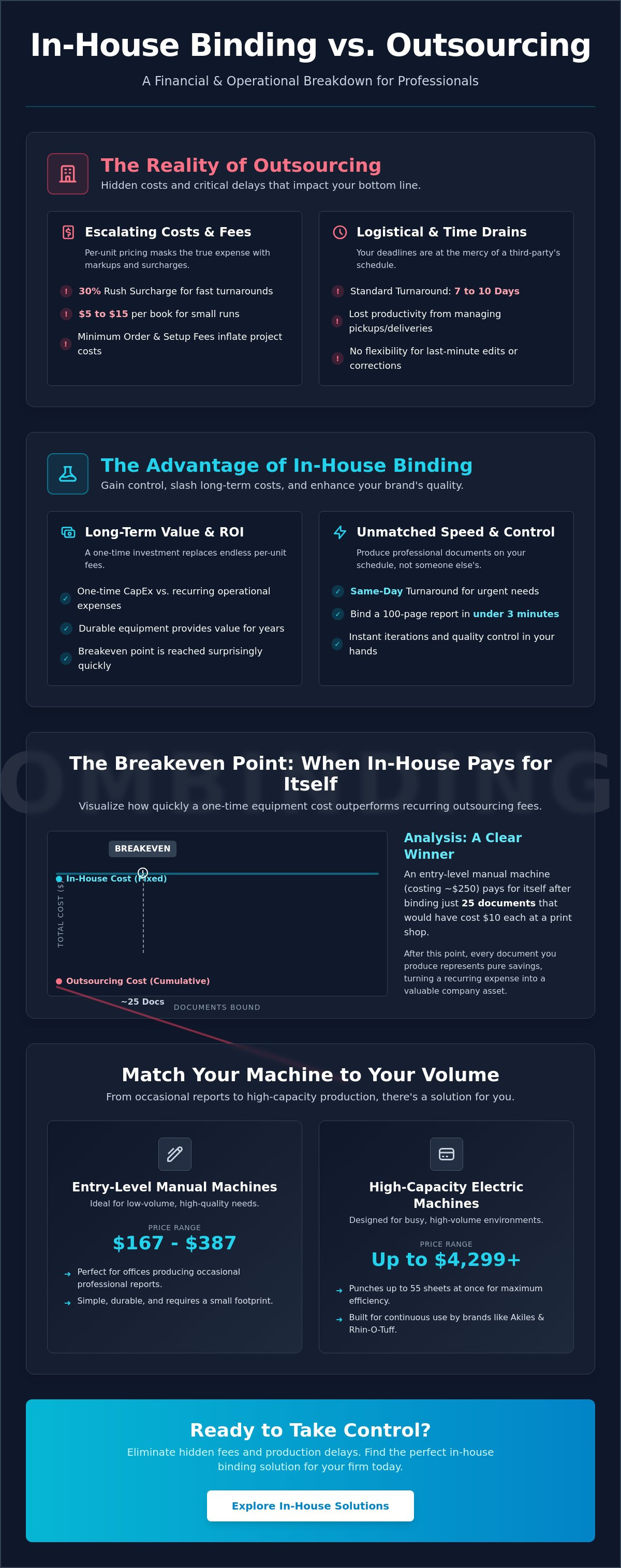
For small runs of 10 to 50 documents, print shops typically charge between $5 and $15 per book for standard wire or coil binding. Even at higher volumes, the savings are limited. As of May 2026, a 48-page perfect-bound catalog costs approximately $2.50 to $3.25 per piece for a quantity of 1,000. The "minimum order" fee remains a primary pain point for professionals. If you only need five high-value presentations, you might still pay a setup fee designed for 50 units. When you factor in the cost of in-house binding vs outsourcing, these fees make small, bespoke runs prohibitively expensive. Premium add-ons like clear acetate covers or heavy-gauge Regency Composition covers only widen this financial gap.
The Flexibility Gap: Why Outsourcing Limits Last-Minute Edits
Outsourcing creates a rigid, non-linear workflow. If a partner spots a typo on page three after the reports are bound, you face a full re-binding fee and another 72-hour wait. You lose the ability to perform instant iterations minutes before a board meeting. This lack of control is particularly felt in the San Diego market, where local print shops have reported increasing turnaround times throughout 2026. Standard turnarounds now average 7 to 10 days. If you need it faster, expect a rush surcharge of 20% to 30%. Bringing production in-house replaces these delays with same-day turnaround and total creative control over every pitch book and client report.
Calculating the True Investment of In-House Document Finishing
Moving beyond the retail invoice requires a clear look at your internal balance sheet. When analyzing the cost of in-house binding vs outsourcing, the first factor is Capital Expenditure (CapEx). Unlike the ongoing fees of a print shop, a machine is a one-time investment that depreciates over several years. This shift allows for greater Control and Oversight of your production schedule. Modern professional-grade equipment is built for durability, often outlasting cheaper "big box" alternatives by a decade. This longevity ensures that your initial investment continues to provide value long after the machine has paid for itself.
Labor is often a primary concern for managers. However, modern electric punches can handle up to 55 sheets per lift. This means a standard 100-page report can be punched and bound in less than three minutes. When you compare those three minutes of internal labor to the hour spent coordinating an external pickup or managing a delivery, the efficiency gains are undeniable. Most office-grade systems also feature a minimal footprint, requiring less than four square feet of desk space and standard power outlets.
Equipment Selection: Matching Machine to Volume
Entry-level manual binding machines are priced between $167 and $386.99. These are ideal for offices producing occasional professional reports where quality is paramount but volume is low. For high-volume environments, robust electric binding systems provide industrial power. A high-capacity, professional-grade electric modular punch can cost up to $4,299.00. While the upfront price is higher, these machines are designed for continuous use in busy print rooms, offering a much lower cost per document over their lifespan.
Consumables: The Secret to Low Per-Unit Costs
Operational Expenditure (OpEx) is where the real savings accumulate. By purchasing supplies like Plastic Spiral Binding Coils or Twin Loop Binding Wire in bulk, you can reduce your per-unit cost to under $1.50 per document. This is a fraction of the $5 to $15 retail price charged by commercial shops. Keeping a small inventory of Clear Acetate Covers and Regency Composition Covers ensures your team can finish a presentation the moment the data is ready. You can browse our full inventory of professional supplies to see how bulk pricing directly impacts your bottom line. Inventory management becomes a simple task of maintaining a "safety stock" of your most-used pitches and gauges.
The Breakeven Point: When Does In-House Binding Pay for Itself?
Identifying the exact moment your equipment pays for itself requires a shift from viewing binding as a service to viewing it as a capital asset. When evaluating the cost of in-house binding vs outsourcing, most firms reach a "magic number" where the monthly savings on print shop markups exceed the monthly depreciation of a professional machine. For many professional offices, this transition happens much faster than anticipated. A mid-range electric system often justifies its presence on the balance sheet within the first few quarters of operation.
Consider the lifespan of professional-grade hardware. While a print shop bill is a sunk cost that provides no residual value, a machine like the Tamerica Optimus-450 or a GBC CombBind C800pro is a durable asset designed for a decade of service. If you amortize the cost of a $1,269 heavy-duty electric system over ten years, the monthly equipment cost is negligible compared to the recurring 20% to 30% rush fees typical of outsourced projects. In 2026, a San Diego law firm successfully reduced their annual document finishing spend by $4,000 simply by shifting from a local print shop to an in-house Rhin-O-Tuff Onyx HD7700. By eliminating courier fees and retail markups, they achieved full ROI in less than seven months.
The 50-Book-Per-Month Benchmark
At a volume of 50 documents per month, the financial disparity becomes undeniable. Outsourcing this volume at a modest $10 per book results in a $500 monthly expense. Conversely, an in-house operation using high-quality Plastic Spiral Binding Coils and Regency Composition Covers costs approximately $50 per month in supplies, plus the machine payment. At a $10 per-book outsourcing rate, the Akiles CoilMac-M reaches its breakeven point after finishing just 40 professional reports. This rapid return on investment allows firms to redirect capital into other growth areas almost immediately.
Scalability for High-Volume Environments
As document volume increases, the "labor-cost tipping point" dictates when to move from manual to electric systems. While manual machines are efficient for small batches, electric modular punches like the Rhin-O-Tuff HD7700 maximize ROI for large marketing departments by slashing the minutes spent per document. Large-scale production also benefits from the use of Roll Laminating Film, where wholesale pricing significantly lowers the cost per finished piece. By deploying a multi-system setup, organizations ensure that their production capacity scales alongside their business growth without a corresponding spike in service fees.
Beyond the Invoice: Control, Customization, and Professional Identity
The true value of a document often rests in its presentation. While the financial cost of in-house binding vs outsourcing is a primary driver for equipment acquisition, the qualitative benefits of total control frequently offer the highest return. Moving your finishing process in-house transforms a standard report into a bespoke tool for corporate storytelling. It allows you to move away from the "one-size-fits-all" constraints of a local print shop and toward a sophisticated, branded aesthetic that reflects the quality of the work inside the document.
In-house systems eliminate the friction of the "last-minute typo." If a data point changes or a name is misspelled ten minutes before a high-stakes board meeting, your team can reprint and rebind the document immediately. In an outsourced model, this scenario results in either a compromised presentation or a frantic, expensive rush order that may still arrive too late. By maintaining a steady hand over the production process, you ensure that your firm's reputation for precision remains intact. This agility is a critical component of professional success in fast-paced environments.
The Tactile Experience of Professionalism
The physical feel of a document serves as the first point of contact with a client. A presentation bound with professional-grade Twin Loop Binding Wire provides a seamless, "lay-flat" experience that feels durable and impressive. You can further elevate this tactile experience by pairing Regency Composition Covers with Clear Acetate Covers to create a polished, multi-layered look. This consistency ensures that every document leaving your office meets the same high standard, regardless of the production volume. Using tools like Dahle Professional Rolling Trimmers ensures clean, sharp edges that reinforce an image of organized efficiency and pride in craftsmanship.
Confidentiality and Security Benefits
For professionals in legal, healthcare, or defense sectors, document security is a non-negotiable requirement. Outsourcing sensitive data to a commercial print center introduces unnecessary risk and potential compliance gaps. Every time a digital file is uploaded or a physical draft is left at a third-party facility, your intellectual property is outside your control. Keeping production within your walls ensures that sensitive financial data and client confidentiality remain protected under your own security protocols. This peace of mind is an invaluable asset that a standard print shop invoice cannot quantify. Browse our selection of professional binding systems to find a solution that secures your internal workflow.
Implementing Your In-House Solution with Custom Binding Products
Transitioning to a professional in-house model requires more than just a purchase; it requires a strategic shift in your operational workflow. While the financial cost of in-house binding vs outsourcing clearly favors the internal move for high-volume offices, the success of that move depends on proper implementation. Custom Binding Products operates as your local partner in San Diego, providing the expert consultation necessary to match specific hardware like the GBC CombBind C800pro or the Akiles CoilMac-M to your unique document volume. We ensure your team isn't just operating a machine, but mastering a craft that reflects your brand's commitment to quality.
Our technicians provide on-site training to ensure your staff is confident and efficient from day one. This hands-on approach eliminates the friction often associated with new equipment. We focus on the technical nuances, such as selecting the correct pitch for Twin Loop Binding Wire or the proper gauge for Plastic Spiral Binding Coils. By the time our session ends, your team will be producing professional-grade presentations that rival any commercial print shop. We don't just ship boxes. We build long-term partnerships that prioritize your professional success and document durability.
Local Service for San Diego Businesses
One primary weakness of nationwide, web-only vendors is the lack of physical support. If a belt snaps or a punch pin requires replacement, a remote vendor leaves you with days of downtime. Custom Binding Products solves this by offering dedicated on-site repair and maintenance for San Diego county. Our local presence ensures that your production line remains active and your deadlines are met without fail. We also provide same-day or next-day delivery for essential supplies like Clear Acetate Covers and Regency Composition Covers. This local responsiveness acts as a safety net for your busy office environment, providing the reliability of a seasoned specialist right in your neighborhood.
Your Document Finishing Roadmap
Taking control of your document finishing is a methodical process. Start by auditing your last six months of print shop invoices to calculate your true cumulative spend, including rush fees and courier charges. Next, identify your most frequent document types. Do you primarily use coil, wire, or comb binding? Understanding your specific needs allows us to recommend a system that scales with your growth. Finally, Contact Custom Binding Products for a tailored ROI analysis to see the exact numbers for your organization. We'll help you navigate the transition from a "cost-per-unit" mindset to a "value-per-presentation" asset, ensuring your office is equipped for the demands of 2026 and beyond.
Secure Your Competitive Edge with Professional In-House Finishing
Deciding between maintaining the status quo and investing in your own production capabilities is a strategic pivot for any growing firm. We've explored how the cost of in-house binding vs outsourcing shifts dramatically in your favor once you account for the hidden logistical drains and retail markups of third-party shops. By moving finishing services inside your walls, you replace long lead times with the confidence of same-day turnaround and absolute control over your intellectual property. This transition transforms a recurring expense into a durable business asset.
Custom Binding Products has supported the San Diego professional community since 1988 with the quiet confidence of a seasoned specialist. We don't just supply hardware like the Rhin-O-Tuff Onyx; we provide a complete ecosystem of reliability through on-site repair services and wholesale pricing on essential supplies. Our goal is to remove the friction from your document preparation, ensuring every report reflects the high standards of your work.
Get a Custom ROI Analysis for Your San Diego Office today to begin your transition. Let's ensure your final presentations deliver the sophisticated, tactile impression your clients expect.
Frequently Asked Questions
Is it difficult to learn how to use a professional binding machine?
No, professional binding systems are designed for intuitive operation and rapid adoption within a busy office. Manual machines like the Akiles CoilMac-M use a simple lever action that most employees master in under 15 minutes. Electric units further simplify the process by using foot pedals for hands-free punching. This ease of use ensures that your staff can produce professional-grade results from day one without extensive technical training.
What is the most durable type of binding for frequently used manuals?
Plastic Spiral Binding Coils are the superior choice for documents that require frequent handling and 360-degree page rotation. These coils are made from a flexible, high-quality polymer that retains its shape even after being crushed or bent. Unlike metal wire, plastic coils won't snag on clothing or lose their alignment in a high-traffic workspace; making them the standard for technical manuals and training guides.
How much space does a heavy-duty binding machine require in an office?
Most heavy-duty modular punches occupy a footprint of less than four square feet. These machines are designed to sit comfortably on a standard 30-inch deep workstation or a dedicated mailroom table. Because they operate with a vertical or horizontal punch throat, they don't require extensive clearance. This compact design allows even small administrative hubs to maintain a full production line without sacrificing valuable floor space.
Can I use my own custom-printed covers with your binding machines?
Yes, professional binding equipment is fully compatible with your existing branded cardstock and custom-printed materials. You can easily punch through heavy stocks or combine your unique designs with Regency Composition Covers for a more sophisticated look. This versatility is a major factor in the cost of in-house binding vs outsourcing; as it allows you to bypass the high markups print shops charge for basic cover stock.
What happens if my binding machine needs repair in San Diego?
Custom Binding Products provides expert on-site repair services for all major brands throughout San Diego county. Our technicians visit your facility to perform diagnostics and mechanical repairs; which eliminates the need to ship heavy equipment to a remote service center. This local support model ensures that your document production faces minimal downtime. We act as a reliable partner to keep your office-grade hardware running at peak performance.
Do I need a special electrical outlet for an electric binding punch?
No, nearly all professional electric binding punches operate on a standard 110v or 120v office outlet. Even high-capacity systems like the Rhin-O-Tuff Onyx HD7700 are designed for plug-and-play use in a typical commercial environment. You don't need to hire an electrician or modify your building's power grid to start saving on your document finishing costs. Simply plug in the machine and begin your first production run.
Is in-house laminating cheaper than using a print shop?
Yes, in-house laminating typically reduces your expenses by 70% compared to retail print shop rates. By purchasing Roll Laminating Film or Laminating Pouches at wholesale prices, you eliminate the high service fees and labor markups found on commercial invoices. This transition is a key component for any organization that regularly produces durable, protected documents and wants to lower their total operational spend.
How long do professional binding machines typically last?
Professional-grade binding machines typically remain in service for 10 to 15 years with routine maintenance. Unlike consumer-grade binders found in big-box stores, industrial hardware from brands like Tamerica and GBC features all-steel construction and hardened punch pins. These machines are durable assets that continue to provide a high return on investment long after the initial purchase price has been amortized across your document runs.
Recent Posts
-
Cost of In-House Binding vs. Outsourcing: The 2026 ROI Guide for Professionals
Is your firm paying a 30% rush surcharge just to get a professional presentation back from the print …May 8th 2026 -
Best Heavy Duty Coil Binding Machines in San Diego: 2026 Professional Roundup
A machine that punches 55 sheets at once is useless if it spends three days a week waiting for a t …May 8th 2026 -
Used Binding Machines for Sale in San Diego: The 2026 Buyer’s Guide
That brand-new, entry-level plastic binder might seem like a safe investment, but the most reliabl …May 8th 2026