
How to Choose a Binding Machine for a Small Business in 2026
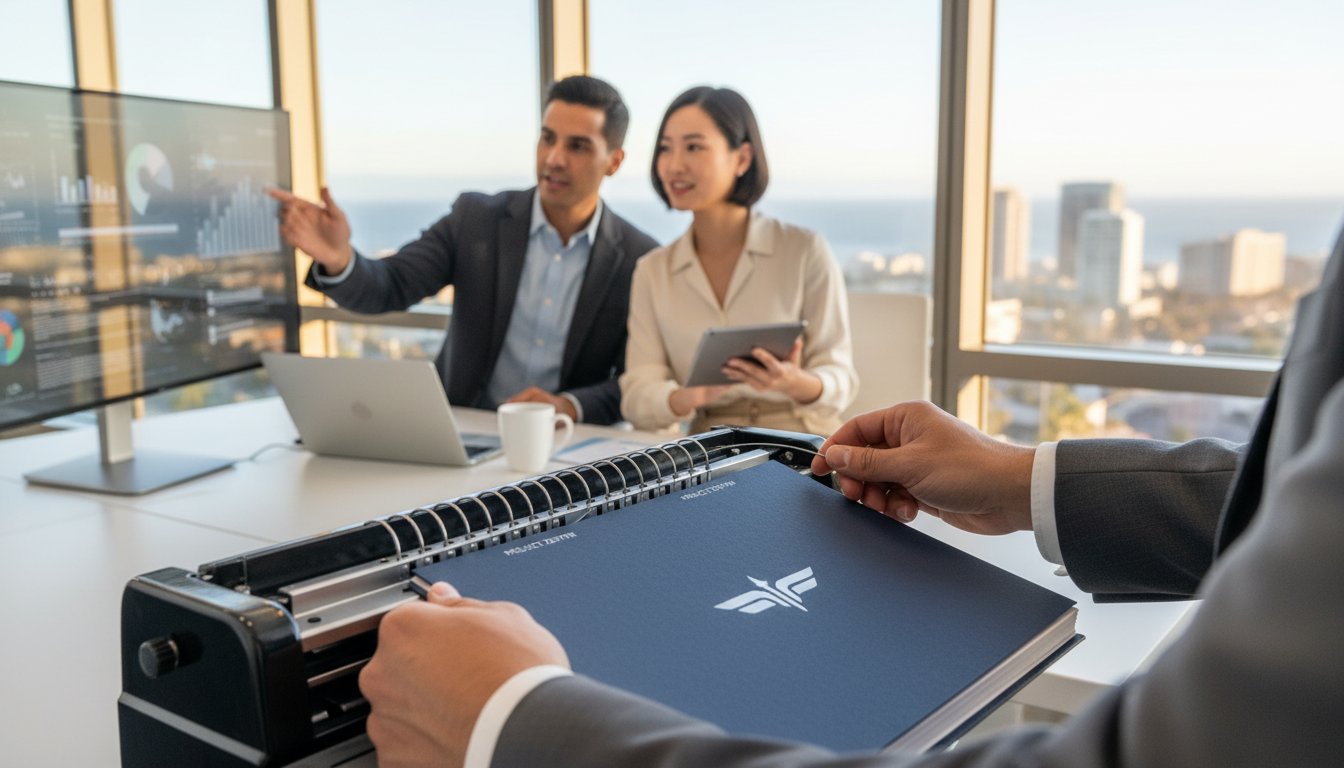
With the global binding machine market projected to reach $1.64 billion in 2026, the demand for sophisticated document finishing has never been higher. You've likely experienced the frustration of a high-stakes report falling apart in a client's hands or felt the drain of wasting hours on manual punching. It's difficult to project authority when you're navigating confusing technical terms like 4:1 pitch and machines that jam during a deadline. Understanding how to choose a binding machine for a small business is an investment in your brand's image; it ensures the tactile quality of your report matches the expertise within its pages.
We believe every document should feel like a bespoke presentation rather than a generic office task. This guide will help you master the technical nuances of document finishing to select a binding system that elevates your brand and fits your workflow perfectly. You'll gain a clear understanding of supply compatibility, compare professional-grade hardware like the Akiles CoilMac-M, and learn why automatic machines now account for 45% of market sales. By the end, you'll have the confidence to choose a durable solution that delivers a seamless, impressive result every time.
Key Takeaways
- Learn how specific binding styles, such as plastic coils or twin-loop wire, serve as tactile ambassadors for your brand’s reputation.
- Discover how to choose a binding machine for a small business by calculating your true monthly volume and avoiding common punch capacity traps.
- Demystify industry terminology like pitch and gauge to ensure your hardware perfectly matches your document thickness and supply needs.
- Identify the hidden long-term costs of document finishing and learn why investing in professional-grade supplies saves more than choosing the cheapest machine.
- Leverage specialist recommendations to find a durable, bespoke solution that streamlines your office workflow and prevents document failure.
Defining Your Professional Identity Through Binding Styles
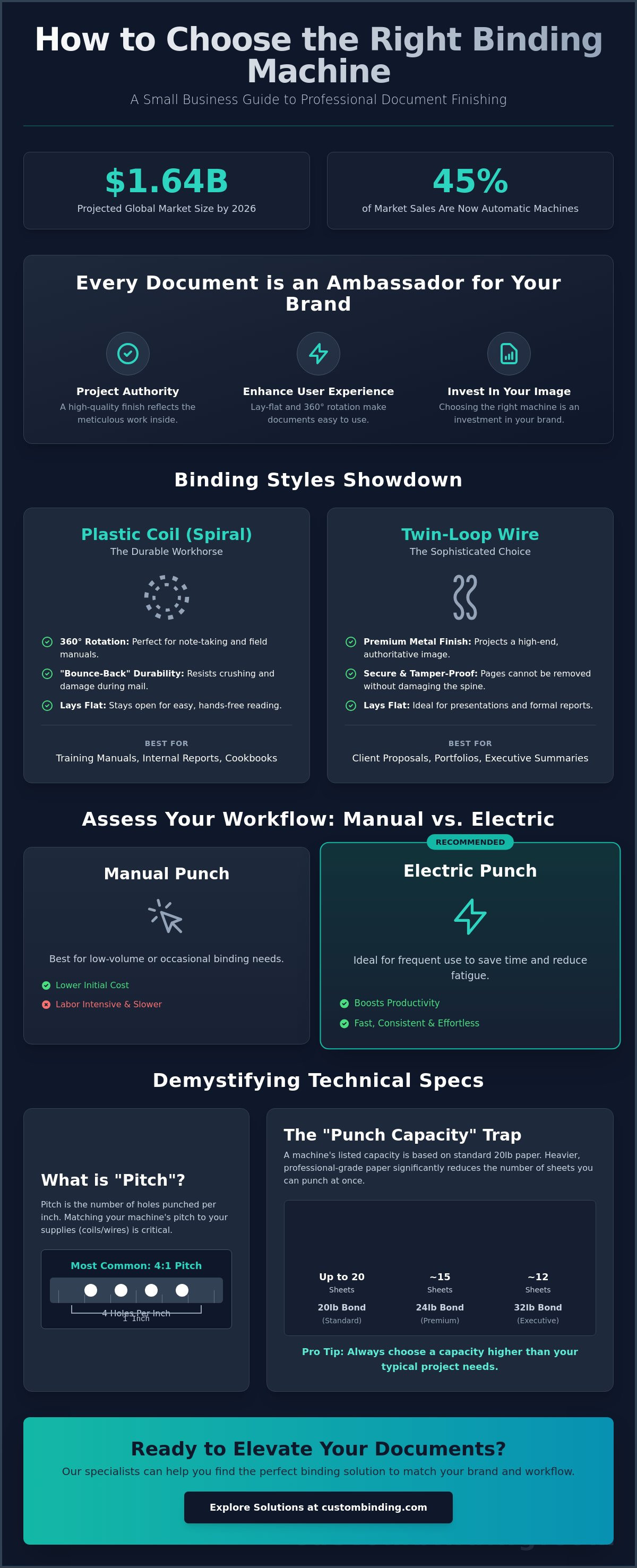
Every document you hand to a client acts as a silent ambassador for your business. It's the first physical interaction they have with your work. If a report feels flimsy or difficult to read, it undermines the professional expertise contained within the pages. When you research how to choose a binding machine for a small business, you're really deciding how you want your brand to be felt. The tactile experience of a document, from the weight of the cover to the smoothness of the page turn, creates a lasting psychological impact. High-quality finishing suggests that the work inside is equally meticulous.
Consider the functional requirements of your client meetings. A document that stays flat on a boardroom table allows for a seamless presentation. In contrast, a report that constantly flips shut creates a subtle but persistent friction. Various Bookbinding styles and methods offer different levels of flexibility for these scenarios. For field manuals or technical guides, 360-degree rotation is essential. It allows the user to fold the document back on itself without damaging the spine. This level of utility reflects an organized, efficient business model that values the end-user experience.
- Lay-flat ability: Essential for hands-free reading during presentations.
- 360-degree rotation: Perfect for field manuals and note-taking.
- Mailing resilience: Flexible coils prevent damage during transit.
Plastic Coil (Spiral) Binding: The Durable Workhorse
Plastic Spiral Binding Coils are the standard for high-use documents. For most small businesses, a 4:1 pitch system provides the ideal balance of strength and aesthetics. This pitch places four holes per inch, ensuring the pages turn without catching. This style is known for its bounce-back factor. Coils are made of flexible PVC that retains its shape even after being crushed in a briefcase or sent through the mail. Use this style for training manuals, internal reports, or any document that needs to survive heavy handling. Machines like the Akiles CoilMac-M make this process efficient and reliable for any office environment.
Twin Loop Wire Binding: The Sophisticated Choice
When a project demands a bespoke, high-end finish, Twin Loop Binding Wire is the professional choice. Often used for executive summaries and real estate portfolios, wire binding provides a sophisticated metal look that plastic cannot replicate. The double-loop design isn't just about appearance. It offers a level of security that prevents page tampering. The wire must be physically cut to remove or add a sheet, which protects the integrity of your data. It's the preferred method for formal proposals where the finishing touch needs to project authority. Selecting the right wire system is a critical step in understanding how to choose a binding machine for a small business that targets high-value clientele.
Assessing Your Workflow: Manual vs. Electric Punching
Before selecting hardware, audit your production volume to ensure the investment aligns with your operational reality. Selecting the right equipment isn't just about the initial price; it's about the labor hours saved over the machine's lifespan. If your team spends several hours a week physically pulling a lever, you're losing billable time. In a professional environment, efficiency is as much a part of your brand as the final document. Understanding your specific throughput is the first step in learning how to choose a binding machine for a small business that actually grows with you.
The "Punch Capacity" trap is a common hurdle for new buyers. Most manufacturers list capacity based on standard 20lb bond paper, but small businesses often use 24lb or 32lb paper to achieve a more professional, bespoke feel. A machine rated for 20 sheets might only handle 12 to 15 sheets of premium stock comfortably, which is a vital distinction when researching how to choose a binding machine for a small business. To dive deeper into these mechanical differences, consult this comprehensive guide to binding machines which details how paper weight impacts hardware performance. Always choose a machine with a punch capacity slightly higher than your thickest document section to prevent mechanical strain.
Space and ergonomics also play a critical role, especially in compact San Diego office environments where every square foot counts. Manual machines require significant physical clearance for the lever's arc, whereas electric models often feature a smaller footprint and foot-pedal operation. This setup reduces operator fatigue and keeps both hands free to align the paper, which significantly improves accuracy. If you're unsure which workflow fits your specific volume, our specialists at Custom Binding Products can help you calculate the return on investment for each system.
When to Stick with Manual Punching
Manual punching is the most cost-effective solution for businesses binding fewer than 10 documents per week. Entry-level machines like the Akiles CoilMac-M offer professional-grade durability without the price tag of electric motors. Look for features like disengageable pins, which allow you to punch non-standard paper sizes without leaving partial holes at the edge. These machines are reliable workhorses for occasional reports or architectural bids that require a steady hand and a precise finish.
The Case for Electric Finishing
As automatic binding machines now account for 45% of market sales in 2026, the shift toward electric finishing is clear. High-volume offices benefit immensely from heavy-duty modular punches like the Rhin-O-Tuff Onyx HD7700. These systems allow you to switch die sets in seconds, handling everything from plastic coils to twin-loop wire. When paired with an electric coil inserter, assembly time drops by nearly 60%. This speed is essential for print-heavy workflows where the goal is to move from a digital file to a finished, elegant presentation in minutes.
Technical Specifications: Pitch, Gauge, and Capacity
Selecting the right hardware requires a clear understanding of the technical specifications that govern supply compatibility. If you've already identified your preferred style and workflow, the next step in learning how to choose a binding machine for a small business is matching the machine's mechanical limits to your document requirements. Precision here prevents the frustration of purchasing a high-end machine only to find it's incompatible with the specific coils or wires you've ordered. These specifications are the foundation of a reliable production process.
The most critical term to master is "pitch." In the context of Mechanical Binding, pitch refers to the spacing of the punched holes along the edge of your paper. Pitch is defined as the distance between hole centers to ensure supply compatibility. For example, a 4:1 pitch machine punches four holes per inch and requires a matching 4:1 plastic coil. Using a 3:1 wire in a 4:1 punched document is impossible; the holes simply won't align. Most small business machines are dedicated to a single pitch, though modular units like the Rhin-O-Tuff Onyx HD7700 allow you to swap die sets to handle multiple systems.
Beyond hole spacing, look for an "Open Throat" design. This feature allows you to punch sheets longer than the machine's actual punch throat by using a two-step process. It's essential if your business handles legal-sized documents or oversized architectural portfolios. To ensure a clean finish on custom paper sizes, prioritize machines with disengageable die pins. These allow you to pull a specific pin to stop it from punching, preventing "half-holes" at the edge of the sheet that look unprofessional and amateurish.
Choosing the Right Pitch for Your Project
For standard 8.5x11 documents, 4:1 pitch coil is the most versatile industry standard. It provides enough holes to keep pages secure while allowing for smooth turning. If your brand requires a sleeker, more tightly-spaced metal finish, 3:1 twin-loop wire is the ideal choice for documents up to 9/16 of an inch thick. For massive reports reaching up to 2 inches in thickness, you'll likely need a 2:1 pitch system, which uses larger loops and wider hole spacing to accommodate the increased bulk.
Capacity and Sheet Count Reality
Document thickness isn't just about the number of pages; it's about the total stack height, including covers. Clear Acetate Covers or Regency Composition Covers add significant gauge to your document. A machine's "Depth of Punch" margin control is vital here. This adjustment changes how far the holes are set from the edge of the paper. For a 20-page report, a shallow margin allows for easy page turning. For a 200-page manual, a deeper margin is required to ensure the pages don't tear away from the binding over time. Balancing these technical nuances ensures your final product is as durable as it is impressive.
Total Cost of Ownership: Supplies and Maintenance
Evaluating the purchase price is only the first step in a strategic acquisition. Many entry-level machines appear affordable at first glance, but they often hide significant long-term expenses in the form of proprietary supplies or frequent mechanical failures. A critical factor in how to choose a binding machine for a small business is assessing the total cost of ownership over a five-year lifecycle. High-quality hardware with all-metal construction, such as the Akiles WireMac-31 which retails for approximately $672.50 in 2026, provides a level of durability that plastic-housed alternatives cannot match. Metal frames prevent the internal misalignment that leads to jammed punch pins and uneven holes.
Operating a business in San Diego offers a distinct advantage: access to local technical support and rapid supply replenishment. When a machine requires maintenance, having a partner that understands the mechanical "wear parts," such as handle springs and die pins, ensures your production never grinds to a halt. We focus on brands like Rhin-O-Tuff and Akiles because they prioritize repairability over obsolescence. This approach transforms your equipment from a disposable office expense into a reliable asset that maintains your professional identity year after year.
Ready to invest in a system built for the long haul? Explore our range of professional binding hardware and supplies today.
Hidden Costs of Consumables
The price-per-bind varies significantly across different styles. In 2026, a box of 100 plastic comb spines in 1/4 inch size costs roughly $8.22, while a 100-pack of 1/2-inch plastic spiral coils is priced at $24.77. While coils carry a higher initial cost, their durability often reduces the need for document re-binding. Transitioning to wholesale purchasing for items like roll laminating film and coils can save your business 30% annually compared to retail-rate office supply stores. To achieve a truly bespoke look, pair these supplies with Clear Acetate Covers or Regency Composition Covers, which provide the high-end tactile finish executive clients expect.
Durability and Repairability
Identify the mechanical limits of your chosen system before a deadline arrives. Heavy-duty modular punches are designed for high-volume environments where the motor might run for several hours daily. These machines use hardened steel dies that stay sharp longer than those found in home-office models. For local San Diego firms, on-site maintenance services prevent the logistical nightmare of shipping a 50-pound machine for repairs. By selecting hardware with readily available replacement parts, you ensure that a minor component failure doesn't result in the total replacement of your binding system.
The Custom Binding Advantage: Specialist Recommendations
Custom Binding Products has operated as a San Diego staple since 1988, providing the expertise required to turn standard office documents into professional assets. We operate with the quiet confidence of a seasoned specialist, focusing on the human element of branding and presentation. Our role is to remove the friction from your document preparation process. Deciding how to choose a binding machine for a small business shouldn't be a guessing game; it's a strategic decision that benefits from our decades of hands-on experience with professional-grade hardware.
We've curated a selection of machines that prioritize craftsmanship and longevity. Our Reliable Specialist approach ensures that every recommendation aligns with your workflow and aesthetics. We understand that in the business world, the first impression is often a tactile one. By pairing specific product features with tangible business benefits, we help you make an informed investment in your brand's image. This methodical selection process prevents you from feeling overwhelmed by technical choices.
Top Recommended Models for 2026
- Akiles CoilMac-M: This remains our best overall recommendation for versatility. Its all-metal construction and disengageable pins make it a durable, professional-grade workhorse for any small office environment.
- Rhin-O-Tuff Onyx HD7700: As automatic binding machines now account for 45% of market sales in 2026, this heavy-duty modular punch is the premier choice for growing teams. It allows you to switch between various binding styles in seconds using interchangeable die sets.
- Tamerica Optimus-450: This system serves as a reliable partner for businesses needing a sophisticated approach to both laminating and document finishing.
Your Next Steps to Professional Presentation
Mastering how to choose a binding machine for a small business is easier when you can see the results in person. Elevating your brand starts with the right materials. We encourage you to request samples of our Plastic Spiral Binding Coils or Regency Composition Covers to feel the quality firsthand. If you're located in Southern California, schedule a demo in our San Diego showroom to test the hardware before you buy. This ensures you find a system that fits your hands and your workspace perfectly.
Take the final step toward organized efficiency. Explore our full range of professional binding machines and find the hardware that will serve as the foundation for your corporate storytelling for years to come. Our team is ready to help you find the perfect finishing touch.
Finalize Your Professional Presentation Strategy
Selecting the right binding system ensures your documents reflect the same precision as the work inside them. You've learned how technical specifications like pitch and margin depth dictate supply compatibility, and why the shift toward 45% automated sales in the 2026 market makes electric finishing a wise investment. Mastering how to choose a binding machine for a small business is about balancing these mechanical capabilities with your brand’s need for a bespoke, durable finish.
Custom Binding Products has served the San Diego business community as a reliable specialist since 1988. As an authorized dealer for industry leaders like Akiles and Rhin-O-Tuff, we provide more than just hardware; we offer the security of on-site repair services and deep technical expertise. We take pride in helping you find a solution that removes friction from your workflow and adds an elegant finishing touch to every report.
Ready to transform your document production? Request a Professional Binding Consultation today to find a system tailored to your unique requirements. We look forward to partnering in your professional success.
Frequently Asked Questions
What is the most popular binding style for small businesses in 2026?
Plastic Spiral Binding Coils are the most popular style in 2026 because they offer the best balance of durability and functionality. They allow documents to lay flat and rotate 360 degrees, which is essential for training manuals. As the global market grows toward $1.64 billion this year, businesses continue to favor this style for its resilience during transit. It's the most versatile choice for a wide range of document thicknesses.
Can I use the same machine for both coil and wire binding?
Most machines are dedicated to a single style, but modular systems like the Rhin-O-Tuff Onyx HD7700 allow you to switch between coil and wire by changing die sets. Standard machines have fixed hole patterns and pitches that aren't interchangeable. Understanding these mechanical limits is a key part of how to choose a binding machine for a small business. Always verify if a machine requires separate finishing equipment, like a wire closer or coil inserter.
How many pages can a standard small business binding machine handle?
A standard small business machine typically handles documents up to 1 inch thick, which is approximately 200 sheets of 20lb paper. High-capacity models can manage stacks up to 2 inches thick, or roughly 450 sheets. Remember that using heavy covers like Regency Composition Covers will reduce the total sheet count. Always check the machine's maximum punch depth to ensure the holes are set far enough from the edge for thicker reports.
Is electric punching worth the extra cost for a small office?
Electric punching is worth the investment for any office binding more than 15 documents per week. It significantly reduces operator fatigue and cuts assembly time by approximately 60% compared to manual lever systems. This efficiency allows your team to focus on higher-value tasks during busy production cycles. For smaller volumes, manual machines like the Akiles CoilMac-M remain a durable and cost-effective alternative for professional finishing.
What is 'pitch' and why does it matter for my binding supplies?
Pitch refers to the number of holes punched per inch along the document's edge. It's the most critical specification for ensuring your supplies fit your hardware. For example, a 4:1 pitch means there are four holes per inch, requiring 4:1 plastic coils. If you use the wrong supplies, the holes won't align. Mastering this term is essential when learning how to choose a binding machine for a small business to avoid costly supply errors.
Where can I get my binding machine repaired in San Diego?
Custom Binding Products provides specialized on-site repair and technical support for businesses throughout the San Diego area. We've been a local staple since 1988, offering maintenance for authorized brands like Akiles and Rhin-O-Tuff. Keeping your equipment in peak condition prevents downtime during critical project deadlines. Our technicians understand the specific wear parts of these machines, ensuring your investment remains reliable for years of professional document production.
Are plastic coils or metal wires more durable for frequent use?
Plastic coils are generally more durable for documents that face frequent handling or mailing. They feature a bounce-back quality that allows them to retain their shape even after being compressed. Twin Loop Binding Wire offers a more sophisticated, executive look but can be permanently bent if mishandled. Choose plastic for internal manuals and training guides; reserve metal wire for high-stakes proposals where the aesthetic finish is the primary priority.
What accessories do I need to get started with a new binding machine?
To begin binding, you'll need the binding elements, front and back covers, and specific finishing tools. For coil binding, crimping pliers are required to cut and crimp the ends of the plastic spiral. Wire binding requires a wire closer, which is often built into the machine. We recommend starting with Clear Acetate Covers and Regency Composition Covers to provide your reports with a professional, bespoke appearance that protects the pages within.
Recent Posts
-
How to Choose a Binding Machine for a Small Business in 2026
With the global binding machine market projected to reach $1.64 billion in 2026, the demand for so …May 9th 2026 -
Cost of In-House Binding vs. Outsourcing: The 2026 ROI Guide for Professionals
Is your firm paying a 30% rush surcharge just to get a professional presentation back from the print …May 8th 2026 -
Best Heavy Duty Coil Binding Machines in San Diego: 2026 Professional Roundup
A machine that punches 55 sheets at once is useless if it spends three days a week waiting for a t …May 8th 2026